Warehouse
Faster picking
How many more orders leave before the courier comes?
A company is about to buy software that promises: “with it, work will go faster”. Taking that on faith is hard. STEND shows in advance whether work really gets faster, on that company’s own work.
For companies that sell software to other businesses. The studio is in closed testing: today we work through pilots.
The studio below is closed while we test it. For now we run it with you as a pilot: you send the description of your client's process, we build and check the model, and you get the report in one to two days.
Discuss a pilot →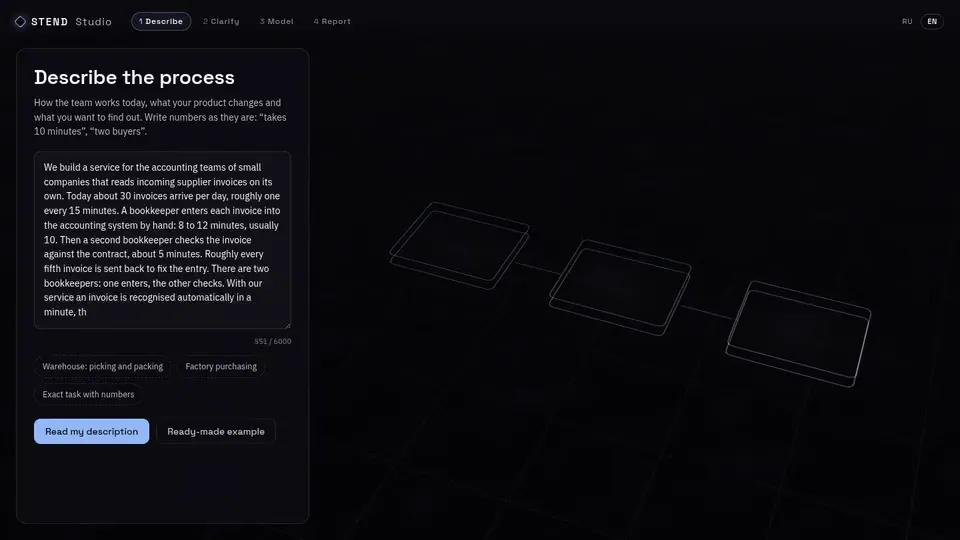
Tell us in your own words how the work goes today and what your product changes. Numbers as you know them.
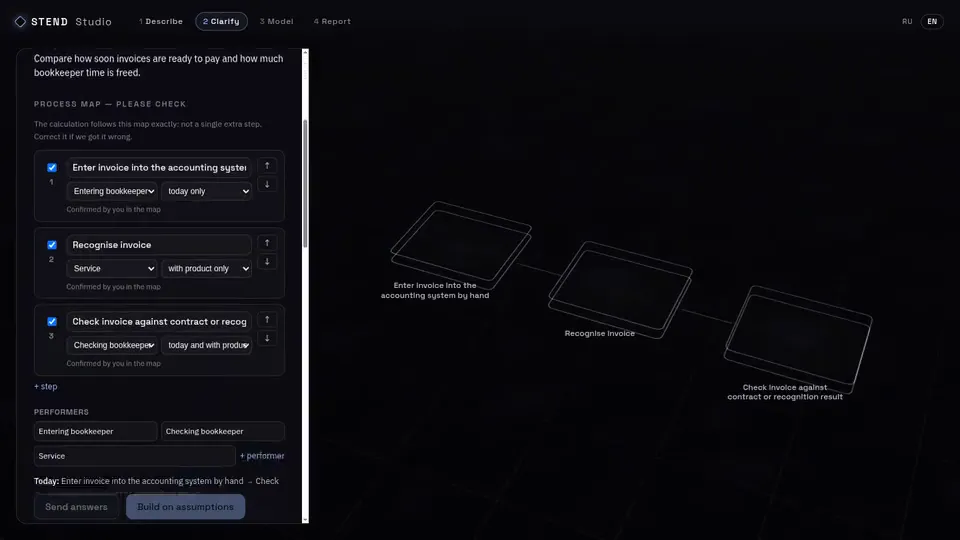
STEND shows the stages and people it understood, with your words for each. You correct the scheme; the model is built only from it.
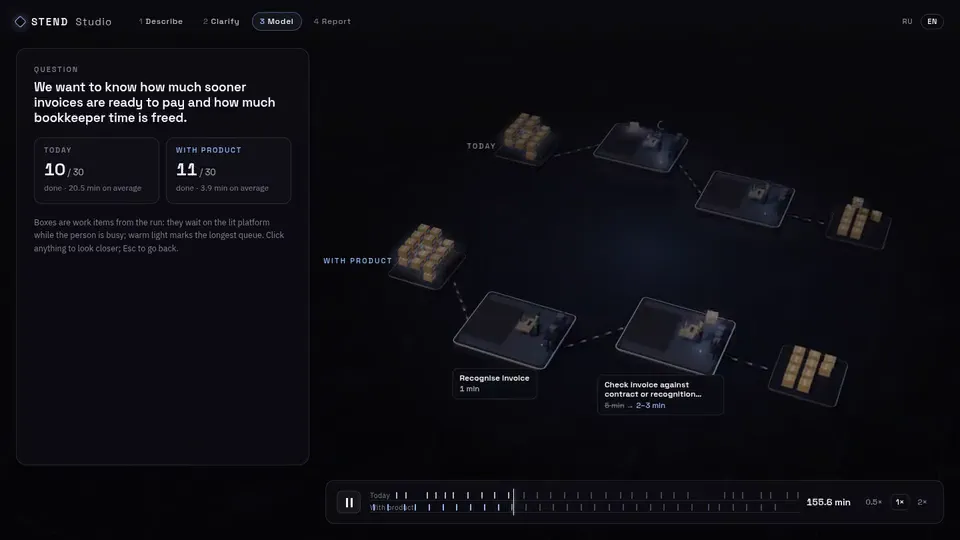
A virtual team works through the same items twice: today and with your product. Every motion is an engine event.
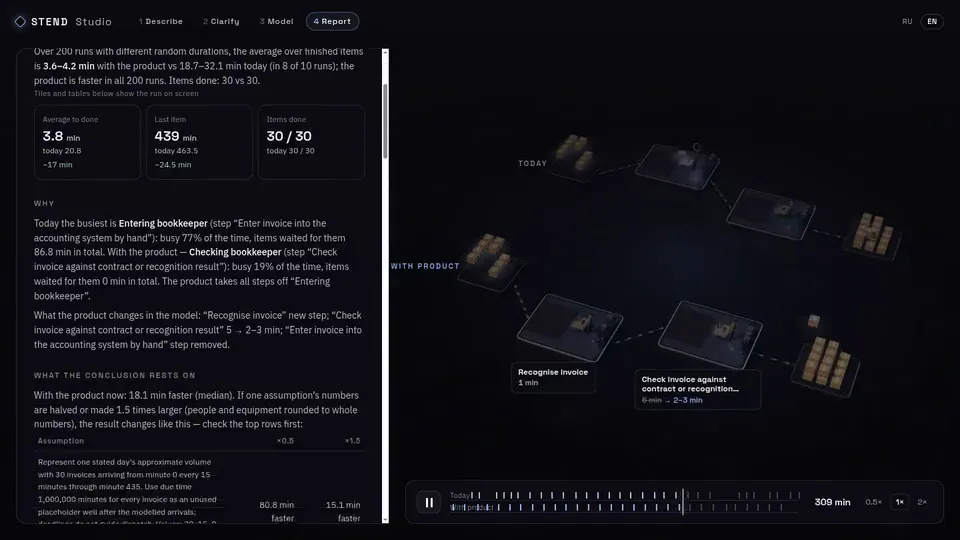
The typical result over 200 runs, where items wait and why, and which assumption the conclusion rests on.
Items, people, stages, queues, returns and schedules. If work flows through a team, it can be modelled. These are examples of questions, not results.
Faster picking
How many more orders leave before the courier comes?
Invoices recognised automatically
How much sooner are invoices ready to pay?
Automatic requests for offers
Does once-a-day approval stay the slowest step?
Automatic ticket routing
Does the queue move to the specialists?
Online check-in
How long do patients really wait for the doctor?
Order screen instead of paper
Do dishes for one table come out together?
Smarter cleaning order
How long does a guest wait for a ready room?
Fewer changeovers
Does the line finish the shift plan?
Each stage and person in the model points to what you wrote or confirmed. Nothing is added on our side.
The language model only reads your description. Every figure in the report is counted from the run.
Anything you did not state is listed as an assumption, and the report shows which ones move the result.
Uncertain times are run 200 times. You see the typical result and how far it can go.
If a rule cannot be modelled yet, STEND says so instead of quietly answering a different process.
For B2B founders and product teams with one concrete operational question.
Describe how the work happens today and what your product would change. You get both versions compared on a model of that workflow, and a list of assumptions worth checking in real work.
You describe your product and the workflow it changes in writing. We agree one question in messages.
We build a model of that workflow and agree the assumptions with you.
You get “as it is now” against “with your product”, and what to check in real work.
First 3 pilots this month are free; after that a pilot is about $500. You get the report in 2 days.